




Appointments
Request Appointment/Request Exam - After completing the respective forms, these requests will be processed by our services, and you will receive confirmation by email. The indications about the Agreements (Insurance/Subsystem) are merely informative, please request confirmation in the "Observations" field.
Schedule Appointment/Exam myHPA - By accessing myHPA Saúde you can make the appointment in real time, directly on the Doctor's schedule according to his availability.
You can also contact us at +351 282 420 400 Algarve | +351 269 630 370 Alentejo | +351 291 003 300 Madeira
Phone booking/service hours:
Monday to Friday: 8:00 AM to 7:00 PM, Saturday: 8:00 AM to 5:00 PM Sunday and Holidays: Closed
(National landline)
Your request has been successfully received. We will confirm your appointment shortly.
Download myHPA Saúde:


Ulcerative Colitis
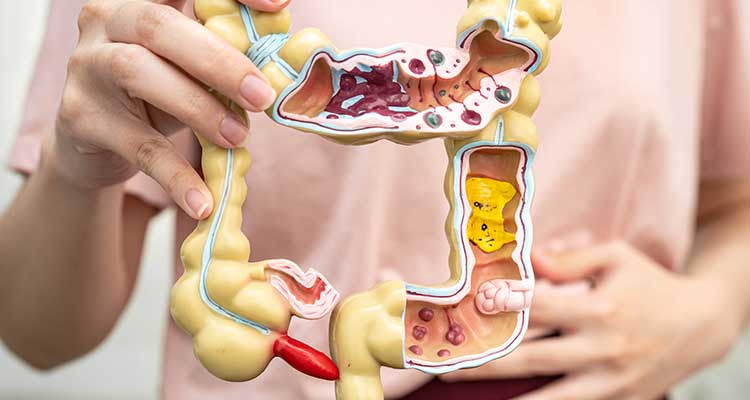
Ulcerative colitis, also known as ulcerative proctocolitis, is a chronic inflammatory disease of the large intestine, characterised by continuous inflammation of the mucosa of the colon and rectum, which may lead to ulcer formation. It mainly presents with gastrointestinal symptoms such as diarrhoea, rectal bleeding and abdominal pain, and belongs to the group of inflammatory bowel diseases, alongside Crohn’s disease.
Inflammation typically affects the rectum (ulcerative proctitis) and may progressively extend to the colon. In more extensive forms, the entire large intestine may be involved (pancolitis).
The exact cause of ulcerative colitis remains unknown. Scientific evidence suggests a combination of genetic factors and immune system dysfunction, with certain environmental factors potentially acting as triggers.
Symptoms may vary in severity over time. The most common include:
- Persistent diarrhoea;
- Presence of blood or mucus in the stools;
- Abdominal pain;
- Anaemia and weight loss;
- Infertility;
- Episodes of constipation.
Extra-intestinal manifestations may also occur, such as joint pain and skin or eye changes, usually associated with active phases of the disease.
Diagnosis is based on clinical evaluation, with colonoscopy or rectosigmoidoscopy and biopsy sampling being essential. These examinations confirm the diagnosis, assess disease extent and exclude other conditions with similar symptoms.
Treatment is individualised and guided by a gastroenterologist, with the aims of inducing remission and preventing relapses. It may include:
- Intestinal anti-inflammatory medications;
- Immunomodulators (drugs that regulate the immune system);
- Biological therapies (antibodies targeting specific proteins to block inflammation).
In the vast majority of patients, a normal quality of life is achievable with appropriate follow-up.
Surgery may be required in specific situations, such as severe pancolitis.
Diet and lifestyle
- Maintain a balanced diet tailored to individual needs;
- Avoid foods that worsen symptoms;
- Assess lactose intolerance and adopt lactose-free alternatives if necessary;
- Avoid certain medications, such as non-steroidal anti-inflammatory drugs (NSAIDs), for example ibuprofen;
- Nutritional supplementation may be recommended in cases of significant dietary restrictions.
- Dra. Ana Margarida Vieira
- Dr. André Sancho Ramos
- Dr. Bruno Peixe
- Dra. Helena Tavares de Sousa
- Dra. Maria Margarida Sampaio
- Dra. Patrícia Queirós
- Dra. Ana Rita Herculano
- Dr. André Sancho Ramos
- Dr. Diamantino Sousa
- Dr. Francisco Açucena
- Dr. Horácio Guerreiro
- Dr. Mário César
- Dr. Horácio Guerreiro
CUF Alvor Hospital
CUF Faro Hospital
Hospital São Camilo - Portimão
CUF S. Brás de Alportel Clinic
| Find all the information regarding Specialities and Consultations at CUF Healthcare Units in Greater Lisbon, the North, Centre, and the Azores here. |